Gallery openings are chaotic. They are exactly like theater “tech weeks” in every respect, except I don’t have to worry about actors forgetting their lines. Everyone wears their grittiest clothes, stays up past their bedtimes, and prepares frantically for the opening.
In this frenzy, one of the most important works was late coming through customs and wasn’t going to make it in time for the opening of the Indonesian contemporary art exhibition. While I’m not going to say we smuggled the artwork into China from Indonesia (in case the Chinese government happens to be keeping up with my blog), I will say that it arrived hurriedly in the middle of the night without passing through customs, and was magically set up by dawn. The work is a giant metallic racecar. A few days later, I was assigned to take it apart and send it to myself in the mail so it could go through customs the proper way before the government noticed. So Monday morning I learned how to take apart a car, resulting in an approximate 112% increase in manliness.
Today, it came back in the mail and I unpackaged it and put it all back together. Such is the museum life.
In short: I took apart a car, sent it to myself, and put it back together. I think that needed to be recapped.
The cherry on the cake: while I was finally cleaning/polishing it, a woman crept up out of the crowd (who was busy watching me clean/polish the car) and asked: “Excuse me sir, is this a performance piece?”
“Yes,” I replied, straight-faced, “I’m here until August 2nd”.
Wednesday, July 28, 2010
Thursday, July 22, 2010
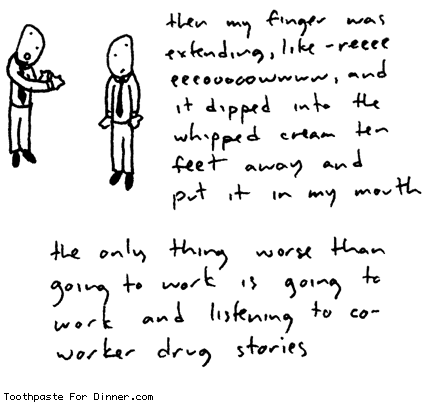
Going to work
In China, “going to work”, is just that: going to work to be at work. Whether or not this means doing anything while you’re there or not, the most important thing is that you’re there, at work. In the Western world, “going to work” is largely associated with being engaged in tasks at one’s workplace. Whether or not this means the tasks are meaningful or even helpful, the most important thing is that you’re busy doing something.
I finally understood this when I was discussing the differences between the Western-run internships and Chinese-run internships with Dean Jones from Yale, who came to visit/check up on us in Shanghai. The interns at Western companies have been busy round-the-clock at work, being put to tasks and always being given something to do (I recall one of my friends quoting her boss as saying, “give me a call if you’re being underutilized and I’ll give you something to do”). Their experience is more of a “program”, though the bulk of their work ends up being busy work and is unused in the company’s final product. At the Chinese-run companies (like MoCA), on the other hand, work is all about waiting for (or begging for) jobs until you’re given a task to complete. I have much more free time during the day (usually a few hours in the morning, a couple in the afternoon on a normal day), but the tasks I end up doing actually need to be done, and I’m often the only one who can do them (such as translating and meeting with people, etc.). So on the one hand, Western companies seem more productive because workers are constantly “working”, but on the other hand Chinese ones are more realistic in that they don’t understand the concept of “busy work” (though staying at work with nothing to do is often frustrating. I usually am constantly asking how I can help out so I won’t feel bad when I spend a couple hours reading a book or step out of the office early to go for a run).
This difference is extremely important to understand for any Westerner who plans on working with Chinese companies in the future. Understanding this subtle difference can save you from mounds of frustration (as it could have saved me a month or so ago).
And NOW YOU KNOW.
I finally understood this when I was discussing the differences between the Western-run internships and Chinese-run internships with Dean Jones from Yale, who came to visit/check up on us in Shanghai. The interns at Western companies have been busy round-the-clock at work, being put to tasks and always being given something to do (I recall one of my friends quoting her boss as saying, “give me a call if you’re being underutilized and I’ll give you something to do”). Their experience is more of a “program”, though the bulk of their work ends up being busy work and is unused in the company’s final product. At the Chinese-run companies (like MoCA), on the other hand, work is all about waiting for (or begging for) jobs until you’re given a task to complete. I have much more free time during the day (usually a few hours in the morning, a couple in the afternoon on a normal day), but the tasks I end up doing actually need to be done, and I’m often the only one who can do them (such as translating and meeting with people, etc.). So on the one hand, Western companies seem more productive because workers are constantly “working”, but on the other hand Chinese ones are more realistic in that they don’t understand the concept of “busy work” (though staying at work with nothing to do is often frustrating. I usually am constantly asking how I can help out so I won’t feel bad when I spend a couple hours reading a book or step out of the office early to go for a run).
This difference is extremely important to understand for any Westerner who plans on working with Chinese companies in the future. Understanding this subtle difference can save you from mounds of frustration (as it could have saved me a month or so ago).
And NOW YOU KNOW.
Wednesday, July 21, 2010
Will and David, the concert series
One of the many places our concert took us.
(I also uploaded it to Youtube in case you couldn't watch the video here: http://www.youtube.com/watch?v=F0HLA9r4Z-c)
An Uneventful Day
“Today was a normal day.”
Let me explain: I woke up, pulled on my running shorts, and stumbled out the door, just like any other day. I waved to every security guard along my running route, returning the occasional “good morning’s” one by one as I clipped along the riverside. I finished the run and stretched, no surprises, no mishaps. I went to work, and I took the subway. I always take the subway. But this time, just like lots of other times, it was completely and conventionally uneventful. As predicted, the third stop on the route – the only one that opens from the right side, instead of the left like all the others – made the foreigners and newcomers stick out like sore thumbs as they stumbled around, nearly missing their stop. I was one of them a couple months ago, but now the other regulars smirk with me, not at me, as we judge the newcomers. A few minutes later, I nodded and smiled at the guards at MoCA as I strolled into work, barely remembering the first two weeks they spent trying to keep me out (thinking I was a tourist). I went to work, came home, and finished out the un-calamitous day.
Maybe this isn’t what I’m supposed to be blogging about. But these things are what makes the city feel a little more like “home”. It creeps up on you when you spend some time fully acclimated to a city. And now that I’ve gotten here, I’m ready to go back. The days are dwindling down in Shanghaiville; it’s reached that point in the summer where the days finally start flickering by, and the U.S. and Yale and Trumbull and my room all finally re-work their way to the top of “places I want to be”.
Peregrine, one of my favorite people, came to visit last weekend. She took last year off to study and work in China and London and so we caught up on our past years and shared our ridiculous stories. She, Della, and I visited Shanghai two years ago before our first China summer program, so we spent some time re-enacting that trip and being floored by (for once, not how much China has changed, but rather) how much we’d changed. Our language alone made Shanghai a different place, and our newly-gained comfort with the culture made wandering through the city a more comfortable experience than NYC could offer, and a much more introspective one. I guess that’s what you get for a college education.
At MoCA, we’re switching to the last exhibition I’ll see: the Contemporary Art of Indonesia. I was dumbfounded yesterday when the artists put me in charge of installing a couple of their art installations, and found myself atop a ladder putting my basic carpentry skills to work. Most of all, I was surprised how much control the artists were willing to give up in the installation of their art. I had creative power in deciding how exactly to space banners, pin cloth up, etc., and it made me think that art is slightly more collaborative than even the artists themselves realize. And also during work last week, my coworkers took me to buy books that I have since busied myself with. I bought Chinese classics translated from ancient Chinese into modern Chinese (so I can read it). Maybe I’ll read these instead of taking Chinese classes this year.
I hit 121 last week. I’m no longer afraid of mileage.
Let me explain: I woke up, pulled on my running shorts, and stumbled out the door, just like any other day. I waved to every security guard along my running route, returning the occasional “good morning’s” one by one as I clipped along the riverside. I finished the run and stretched, no surprises, no mishaps. I went to work, and I took the subway. I always take the subway. But this time, just like lots of other times, it was completely and conventionally uneventful. As predicted, the third stop on the route – the only one that opens from the right side, instead of the left like all the others – made the foreigners and newcomers stick out like sore thumbs as they stumbled around, nearly missing their stop. I was one of them a couple months ago, but now the other regulars smirk with me, not at me, as we judge the newcomers. A few minutes later, I nodded and smiled at the guards at MoCA as I strolled into work, barely remembering the first two weeks they spent trying to keep me out (thinking I was a tourist). I went to work, came home, and finished out the un-calamitous day.
Maybe this isn’t what I’m supposed to be blogging about. But these things are what makes the city feel a little more like “home”. It creeps up on you when you spend some time fully acclimated to a city. And now that I’ve gotten here, I’m ready to go back. The days are dwindling down in Shanghaiville; it’s reached that point in the summer where the days finally start flickering by, and the U.S. and Yale and Trumbull and my room all finally re-work their way to the top of “places I want to be”.
Peregrine, one of my favorite people, came to visit last weekend. She took last year off to study and work in China and London and so we caught up on our past years and shared our ridiculous stories. She, Della, and I visited Shanghai two years ago before our first China summer program, so we spent some time re-enacting that trip and being floored by (for once, not how much China has changed, but rather) how much we’d changed. Our language alone made Shanghai a different place, and our newly-gained comfort with the culture made wandering through the city a more comfortable experience than NYC could offer, and a much more introspective one. I guess that’s what you get for a college education.
At MoCA, we’re switching to the last exhibition I’ll see: the Contemporary Art of Indonesia. I was dumbfounded yesterday when the artists put me in charge of installing a couple of their art installations, and found myself atop a ladder putting my basic carpentry skills to work. Most of all, I was surprised how much control the artists were willing to give up in the installation of their art. I had creative power in deciding how exactly to space banners, pin cloth up, etc., and it made me think that art is slightly more collaborative than even the artists themselves realize. And also during work last week, my coworkers took me to buy books that I have since busied myself with. I bought Chinese classics translated from ancient Chinese into modern Chinese (so I can read it). Maybe I’ll read these instead of taking Chinese classes this year.
I hit 121 last week. I’m no longer afraid of mileage.
Sunday, July 11, 2010
The Palidrome Mileage Program
This is the summer of palindromes. My mileage sheet (per week) for the last nine weeks reads: 22, 33, 44, 55, 66, 77, 88, 99, 111. It started as a cutesy way to get to where I wanted to be by July, and turned into a mileage program to see if my body could handle high mileage. Ever since I read the running cult book “Once A Runner” my freshman year, I’ve wondered if my body could hold up over 120 miles/week, and this might be the best chance I have at finding out. While it might look like I’m finished at 111, the last step in my Palindrome Mileage Program is 121. If I don’t make it there this week (or even if I do), I’ve got all of August.
What’s it like running the highest mileage of my life in Shanghai? It’s learning to be OK with being gross and disgusting as you hop by thousands of pedestrians every run; it’s like trying to go crazy, running as far as you ever have and consciously deciding “I could go further”; it’s spending your day waiting in between runs; it’s like eating so you can run, making your own food to make sure you’re getting enough protein/calcium, whatever; it’s like this: a curious popping sound started coming from my knee whenever I went too fast without fully warming up and instead of being alarmed, my first thought was that I would be able to better regulate my warm-up this way.
There are several not-so-incredible things about what I’m doing: I’m training in a city with no hills, at sea level, and deciding my own pace day-to-day (though sticking close to a range my coach wants us running at). All this makes hitting high mileage easier and slightly less meaningful. Most serious athletes do their heavy training at high altitude with a team.
There are several incredible things about what I’m doing: I’m putting down lifetime-high mileage from the center of one of the largest, most populated cities in the world, entirely on pavement and without ice baths (to keep my legs from getting injured) during monsoon season in shanghai (heavy pollution + rain = acid rain!). And outside of a monthly e-mail from my coach to the entire team, there’s no one patting my back or cheering me on, though I do get some phenomenal support from the occasional Chinese man on street corners. All this, with a full-time 9-6 job.
Speaking of acid rain I just remembered and looked up an E-mail I sent in 2008 to then-Captain Jake Gallagher:
“I've been in Beijing for a few weeks, but now I'm spending some time backpacking around China. I just got into Shanghai from Qingdao... Between you and me, I'm afraid that with the blinding smog and all-encompassing pavement in Beijing something in my body is going to give up. I'm safe from lung cancer for another week and a half until I return to Beijing, but I still only get about 100 meters of soft surface running a week. Then there’s the acid-rain-ensuing monsoon season. The fiya has got to blaze somehow, eh?”
It’s now Tsunami season again in Shanghai and I’m plugging along all the same. I’m still unclear whether the fact that I hold the same attitude as in 2008 makes me extremely proud of my perseverance or scared of my ignorance and stupidity. Either way, this might be the only chance I have to do this sort of training, and I’m taking life up on the offer.
What’s it like running the highest mileage of my life in Shanghai? It’s learning to be OK with being gross and disgusting as you hop by thousands of pedestrians every run; it’s like trying to go crazy, running as far as you ever have and consciously deciding “I could go further”; it’s spending your day waiting in between runs; it’s like eating so you can run, making your own food to make sure you’re getting enough protein/calcium, whatever; it’s like this: a curious popping sound started coming from my knee whenever I went too fast without fully warming up and instead of being alarmed, my first thought was that I would be able to better regulate my warm-up this way.
There are several not-so-incredible things about what I’m doing: I’m training in a city with no hills, at sea level, and deciding my own pace day-to-day (though sticking close to a range my coach wants us running at). All this makes hitting high mileage easier and slightly less meaningful. Most serious athletes do their heavy training at high altitude with a team.
There are several incredible things about what I’m doing: I’m putting down lifetime-high mileage from the center of one of the largest, most populated cities in the world, entirely on pavement and without ice baths (to keep my legs from getting injured) during monsoon season in shanghai (heavy pollution + rain = acid rain!). And outside of a monthly e-mail from my coach to the entire team, there’s no one patting my back or cheering me on, though I do get some phenomenal support from the occasional Chinese man on street corners. All this, with a full-time 9-6 job.
Speaking of acid rain I just remembered and looked up an E-mail I sent in 2008 to then-Captain Jake Gallagher:
“I've been in Beijing for a few weeks, but now I'm spending some time backpacking around China. I just got into Shanghai from Qingdao... Between you and me, I'm afraid that with the blinding smog and all-encompassing pavement in Beijing something in my body is going to give up. I'm safe from lung cancer for another week and a half until I return to Beijing, but I still only get about 100 meters of soft surface running a week. Then there’s the acid-rain-ensuing monsoon season. The fiya has got to blaze somehow, eh?”
It’s now Tsunami season again in Shanghai and I’m plugging along all the same. I’m still unclear whether the fact that I hold the same attitude as in 2008 makes me extremely proud of my perseverance or scared of my ignorance and stupidity. Either way, this might be the only chance I have to do this sort of training, and I’m taking life up on the offer.
Friday, July 9, 2010
New Faces in Old Patterns (bonus marathon post!)
“What’s wrong?"
“I feel like I’ve been here before,” I said.
“You live here. Or is this like deja-vu?”
“No, not like that –like I’ve been here in time before.”
“Where?”
“The Fourth of July.”
Even though this summer is incomparable to the last two (the people, the day job, the apartment, the food), the summers are blending together. As in, I felt the distinct pattern of “Independence Day in China” like, “Oh. I’ve been here before”. Maybe this is what happens when I’m ready to graduate and move on to something less formulaic (semester-home-semester-China-semester-home-semester China...), or maybe that’s just what happens when you get older and have more things to remember. Either way, I’m starting to see the same old patterns in this summer, but with new faces and places and snacks. Either way, it’s been completely worth it; at the end of the day, each lap of the pattern lets me learn more about the world.
For example: I learned for the hundredth time what the Chinese mean when they say to me (for the thousandth time): “If you want to learn Chinese, you need to get a Chinese girlfriend.” At first I thought they were joking, but it turns out that whether it be girlfriends or a friends you see often (in all my cases, friends), being around them can magically make your Chinese better. But even after I realized that “get a Chinese girlfriend” meant “practice Chinese all the time,” I didn’t fully realize until now that it actually means “make Chinese relevant to yourself”. That is, in discussing the little and Very Big things in life that matter to you, in listening to someone else critique and extend your own opinions, to revise and create new ideas in Chinese is to make it relevant to yourself. The things you learn in those conversations you remember forever.
But that’s not what I sat down to type about.
I finally have my suit! It’s just about exactly what I’d wanted, for whatever that’s worth. I also got custom-made ties and am having fitted shirts made, and maybe a vest (if I can manage to bargain successfully unlike the last two times). The fabric market here makes me feel like a designer. I gave an absurd amount of specifications and style and fabric demands to the tailor. It’s like having a Demres fashion label! “Maybe THAT’S what I’ll do after I graduate” (that thought pops in my head about every other moderately interesting thing I do these days).
Friday I adventured with Becca, going to a few galleries and interviews. The interviews are giving me a good feel for what the art community is like in Shanghai. One of the most fascinating things we’re finding is art galleries’ reluctance to initiate “art community events” to stimulate the art culture in Shanghai. In fact, they often don’t understand the concept of holding art events and festivals to get the entire community excited about art. “In China,” one person answered, “everybody does their own thing... if we encourage people to see more of the art in Shanghai, we lose our own customers.”
As it turns out, the Shanghai art gallery community is a dog-eat-dog business. Interestingly, this goes directly against the standard “socialist” form of thinking, where everyone contributes to the community in order to create a better common good. Under this thinking, the art community would want to work together and pool their customers, not horde them away for themselves. I have two guesses for why this is: One is Western influence: the Shanghai art community has been “mainly written by Western people in the end,” as one person claimed. But although this does have some truth to it, it seems a little Western-centric and arrogant, especially considering there are many Chinese-run galleries in Shanghai. Also, galleries in the West often hold art community events, despite being embedded in a ruthless capitalist system. Two is that (surprise) it’s a cultural adaptation. Chinese history has been wrought with change on political and economic terms; in the last century, this change became more rapid than ever, seeing the fall of the dynasty system that had been in place for some thousands of years in 1911, the quick rise and fall of Nationalist parties in the next twenty years, the shift to communism by 1949, a total upheaval of cultural norms in the 1960’s during Mao’s Cultural Revolution, as well as the rapid opening to the West in more recent years. All of this is to say: the Chinese have necessarily adapted to a volatile government and economy, and in doing so have become accustomed to holding on to what they have, be it family traditions, small plots of land, or their native dialect and heritage. In this case, art gallery owners need to hold on to their customers, lest tomorrow a foreign gallery opens up next store and takes away customers, or the government suddenly turns against art. I think this explanation resonates best with the current situation in China, and also reveals that Chinese people aren’t just products of their government. They are not, despite Western opinion, necessarily “communist” by nature, but rather part of the generational development they are embedded in. When the Western literature can better recognize this, a better understanding of culture will form.
After adventuring that Friday, Becca’s landlord took her, her roommate, and myself out to a long, busy street that sold only crawfish. Crowded into clusters of tiny restaurants, Shanghainese flocked to this street at night; I didn’t spot a single foreigner there. (That’s when you know you’re in for a good time.) We ate pounds of crawfish and I learned how to tear through them. Both Becca and her roommate (who are from the southern US) talked about how crawfish are a “local” specialty, and their landlord (from Shanghai) talked about how they were a local specialty here, and they ended up bonding over childhood experiences of netting crawfish on hot summer days. That they could relate so closely to their experiences with the near-identical “local” on opposite sides of the world was fascinating. What an outrageously globalized world.
I’m translating lots at work, and it’s become a joke that I’m the “translation department” of MoCA. Whenever someone needs something translated, they’re pointed to the translation department, located at my desk. I’m getting good at it, except for: a few days ago, I translated a foreword to a MoCA book being published next month. In the opening sentence, I misread 岛 (island) as 鸟 (bird) (what an idiot, right?), and ended up going on about the birds that make up the famous, sprawling Indonesian landscape. It wasn’t until I saw a Tsingdao beer ad the next day (the second character of Tsingdao is 岛) that I went “oh no” and ran back to my boss. He already had seen it, and laughed and asked me how birds managed to find their way into the foreword. Best of all, the MoCA book for the current exhibition, which I translated, was just published! It is my first published translation, so although I had to spend six hours with the publishers, painstakingly copy-editing last week, it was an exciting process.
I also met casually with the Chairman of the museum and he gave me some outstanding recommendations for my senior thesis pertaining to art in Hong Kong. He’s originally a very wealthy jade investor from there, so he knows the place well. Equally exciting is that I got to check out the layout of the next exhibition with him. He was complaining about the cost of the walls for it and how he didn’t like the look/feel of how the layout was going to be, and on a whim I made a suggestion to get rid of a couple walls, and drastically shorten another one both lengthwise and widthwise. It would open up the museum, allow people to see through the exhibition from the long stairway (and from outside), and save money! He and my co-worker thought it was a good idea and he said he’ll speak to the curator about this. My floor design idea might be incorporated into an exhibition, fun fun. Layouts are just like theater sets, except with more space and money.
Yummy things I have made lately:
- Meatballs. I used what I could find, which was ground pork and lamb. Experimenting with meats for texture, flavor and juiciness is highly recommended.
- Stovetop pizza. One of my best inventions yet. The dough is tricky (I’ve been making more of a pita dough), but it’s really hard to mess this one up.
- Tuna Bisque. Why make soup when you can make Bisque?
- Fried stuff. For 4th of July we had a fryfest and deep-fried onion rings in a beer batter, along with anything else in our refrigerator. There’s an excellent picture on the photoblog. This is not to be confused with Will’s and my quest to make French fries for breakfast. It’s safe to say we’ve been using corn oil like water and frying potatoes nearly every morning in our apartment.
- Creamed spinach with an olive oil béchamel. Because spinach has protein, and Davids eat protein.
Here’s a story about a conflict at work: there is a girl in the marketing department who is stuck up and nobody likes (I feel like there is one of these in every office). She doesn’t really do any work (instead does her make-up and leaves to go for shopping walks). Anyway, she somehow convinced the Chairman here that the Marketing department only needs one person, and to send the other one to another department. We were all confused as to how she was planning on getting the work done, until I figured out she planned on pinning all to me and taking credit for it (this is not my job). Long story short, I ended up calling her out in front of the entire office, to enthusiastic approval. I’ve never chewed out someone so hard in Chinese before – definitely a landmark. I should probably not make a habit of this, though for now the rest of the office is happy with me and (after getting license to do so from my boss) I get to just say “I’m busy doing Education department things” whenever she asks for help, as I go back to reading books.
On that note, I’ve made it a mission to read as many of the books as I can in the office. There are hundreds of art history books and magazines (both in English and Chinese) for the grabbing. I’ve always wanted a personal library, and this is about as close as I’m going to get.
Overall, my boss has been great. After finding out we both like photography, he’s always calling me over to his computer to check out his latest batch of pictures from around the city. He’s got a disgustingly nice Nikon camera, and takes some really great still life pictures. Now every few mornings as soon as I get into work he says, “David! Grab your camera!” and runs out of the room and I follow him to the park or wherever and we take pictures. The Lotus Flowers in People’s Park are breathtaking this time of year, and so we snap our cameras at them for a half hour or so before heading back in. Yesterday he told me to get my camera out in the middle of the day, and we went down into the kitchen and took pictures of the new menu items as the chefs were making them. Can I claim I’ve done professional food photography now? Yes? I can? Good, I’m glad you agree.
Most exciting: he wants to do dinner at my place with everyone at the office, where he cooks Chinese food and I cook Western food and we make a meal. Everyone in the office is holding their breath, I can’t wait.
Also, my boss decided that my homework for the rest of the month is to think about MoCA, analyze the good things and the bad things, and give them an honest “company evaluation” (over dinner) at the end. I’ll make sure to include that here.
Finally, Will and I are preparing for our Shanghai concert series. Stay tuned for more details (and maybe a video). And god bless whoever read this far down.
“I feel like I’ve been here before,” I said.
“You live here. Or is this like deja-vu?”
“No, not like that –like I’ve been here in time before.”
“Where?”
“The Fourth of July.”
Even though this summer is incomparable to the last two (the people, the day job, the apartment, the food), the summers are blending together. As in, I felt the distinct pattern of “Independence Day in China” like, “Oh. I’ve been here before”. Maybe this is what happens when I’m ready to graduate and move on to something less formulaic (semester-home-semester-China-semester-home-semester China...), or maybe that’s just what happens when you get older and have more things to remember. Either way, I’m starting to see the same old patterns in this summer, but with new faces and places and snacks. Either way, it’s been completely worth it; at the end of the day, each lap of the pattern lets me learn more about the world.
For example: I learned for the hundredth time what the Chinese mean when they say to me (for the thousandth time): “If you want to learn Chinese, you need to get a Chinese girlfriend.” At first I thought they were joking, but it turns out that whether it be girlfriends or a friends you see often (in all my cases, friends), being around them can magically make your Chinese better. But even after I realized that “get a Chinese girlfriend” meant “practice Chinese all the time,” I didn’t fully realize until now that it actually means “make Chinese relevant to yourself”. That is, in discussing the little and Very Big things in life that matter to you, in listening to someone else critique and extend your own opinions, to revise and create new ideas in Chinese is to make it relevant to yourself. The things you learn in those conversations you remember forever.
But that’s not what I sat down to type about.
I finally have my suit! It’s just about exactly what I’d wanted, for whatever that’s worth. I also got custom-made ties and am having fitted shirts made, and maybe a vest (if I can manage to bargain successfully unlike the last two times). The fabric market here makes me feel like a designer. I gave an absurd amount of specifications and style and fabric demands to the tailor. It’s like having a Demres fashion label! “Maybe THAT’S what I’ll do after I graduate” (that thought pops in my head about every other moderately interesting thing I do these days).
Friday I adventured with Becca, going to a few galleries and interviews. The interviews are giving me a good feel for what the art community is like in Shanghai. One of the most fascinating things we’re finding is art galleries’ reluctance to initiate “art community events” to stimulate the art culture in Shanghai. In fact, they often don’t understand the concept of holding art events and festivals to get the entire community excited about art. “In China,” one person answered, “everybody does their own thing... if we encourage people to see more of the art in Shanghai, we lose our own customers.”
As it turns out, the Shanghai art gallery community is a dog-eat-dog business. Interestingly, this goes directly against the standard “socialist” form of thinking, where everyone contributes to the community in order to create a better common good. Under this thinking, the art community would want to work together and pool their customers, not horde them away for themselves. I have two guesses for why this is: One is Western influence: the Shanghai art community has been “mainly written by Western people in the end,” as one person claimed. But although this does have some truth to it, it seems a little Western-centric and arrogant, especially considering there are many Chinese-run galleries in Shanghai. Also, galleries in the West often hold art community events, despite being embedded in a ruthless capitalist system. Two is that (surprise) it’s a cultural adaptation. Chinese history has been wrought with change on political and economic terms; in the last century, this change became more rapid than ever, seeing the fall of the dynasty system that had been in place for some thousands of years in 1911, the quick rise and fall of Nationalist parties in the next twenty years, the shift to communism by 1949, a total upheaval of cultural norms in the 1960’s during Mao’s Cultural Revolution, as well as the rapid opening to the West in more recent years. All of this is to say: the Chinese have necessarily adapted to a volatile government and economy, and in doing so have become accustomed to holding on to what they have, be it family traditions, small plots of land, or their native dialect and heritage. In this case, art gallery owners need to hold on to their customers, lest tomorrow a foreign gallery opens up next store and takes away customers, or the government suddenly turns against art. I think this explanation resonates best with the current situation in China, and also reveals that Chinese people aren’t just products of their government. They are not, despite Western opinion, necessarily “communist” by nature, but rather part of the generational development they are embedded in. When the Western literature can better recognize this, a better understanding of culture will form.
After adventuring that Friday, Becca’s landlord took her, her roommate, and myself out to a long, busy street that sold only crawfish. Crowded into clusters of tiny restaurants, Shanghainese flocked to this street at night; I didn’t spot a single foreigner there. (That’s when you know you’re in for a good time.) We ate pounds of crawfish and I learned how to tear through them. Both Becca and her roommate (who are from the southern US) talked about how crawfish are a “local” specialty, and their landlord (from Shanghai) talked about how they were a local specialty here, and they ended up bonding over childhood experiences of netting crawfish on hot summer days. That they could relate so closely to their experiences with the near-identical “local” on opposite sides of the world was fascinating. What an outrageously globalized world.
I’m translating lots at work, and it’s become a joke that I’m the “translation department” of MoCA. Whenever someone needs something translated, they’re pointed to the translation department, located at my desk. I’m getting good at it, except for: a few days ago, I translated a foreword to a MoCA book being published next month. In the opening sentence, I misread 岛 (island) as 鸟 (bird) (what an idiot, right?), and ended up going on about the birds that make up the famous, sprawling Indonesian landscape. It wasn’t until I saw a Tsingdao beer ad the next day (the second character of Tsingdao is 岛) that I went “oh no” and ran back to my boss. He already had seen it, and laughed and asked me how birds managed to find their way into the foreword. Best of all, the MoCA book for the current exhibition, which I translated, was just published! It is my first published translation, so although I had to spend six hours with the publishers, painstakingly copy-editing last week, it was an exciting process.
I also met casually with the Chairman of the museum and he gave me some outstanding recommendations for my senior thesis pertaining to art in Hong Kong. He’s originally a very wealthy jade investor from there, so he knows the place well. Equally exciting is that I got to check out the layout of the next exhibition with him. He was complaining about the cost of the walls for it and how he didn’t like the look/feel of how the layout was going to be, and on a whim I made a suggestion to get rid of a couple walls, and drastically shorten another one both lengthwise and widthwise. It would open up the museum, allow people to see through the exhibition from the long stairway (and from outside), and save money! He and my co-worker thought it was a good idea and he said he’ll speak to the curator about this. My floor design idea might be incorporated into an exhibition, fun fun. Layouts are just like theater sets, except with more space and money.
Yummy things I have made lately:
- Meatballs. I used what I could find, which was ground pork and lamb. Experimenting with meats for texture, flavor and juiciness is highly recommended.
- Stovetop pizza. One of my best inventions yet. The dough is tricky (I’ve been making more of a pita dough), but it’s really hard to mess this one up.
- Tuna Bisque. Why make soup when you can make Bisque?
- Fried stuff. For 4th of July we had a fryfest and deep-fried onion rings in a beer batter, along with anything else in our refrigerator. There’s an excellent picture on the photoblog. This is not to be confused with Will’s and my quest to make French fries for breakfast. It’s safe to say we’ve been using corn oil like water and frying potatoes nearly every morning in our apartment.
- Creamed spinach with an olive oil béchamel. Because spinach has protein, and Davids eat protein.
Here’s a story about a conflict at work: there is a girl in the marketing department who is stuck up and nobody likes (I feel like there is one of these in every office). She doesn’t really do any work (instead does her make-up and leaves to go for shopping walks). Anyway, she somehow convinced the Chairman here that the Marketing department only needs one person, and to send the other one to another department. We were all confused as to how she was planning on getting the work done, until I figured out she planned on pinning all to me and taking credit for it (this is not my job). Long story short, I ended up calling her out in front of the entire office, to enthusiastic approval. I’ve never chewed out someone so hard in Chinese before – definitely a landmark. I should probably not make a habit of this, though for now the rest of the office is happy with me and (after getting license to do so from my boss) I get to just say “I’m busy doing Education department things” whenever she asks for help, as I go back to reading books.
On that note, I’ve made it a mission to read as many of the books as I can in the office. There are hundreds of art history books and magazines (both in English and Chinese) for the grabbing. I’ve always wanted a personal library, and this is about as close as I’m going to get.
Overall, my boss has been great. After finding out we both like photography, he’s always calling me over to his computer to check out his latest batch of pictures from around the city. He’s got a disgustingly nice Nikon camera, and takes some really great still life pictures. Now every few mornings as soon as I get into work he says, “David! Grab your camera!” and runs out of the room and I follow him to the park or wherever and we take pictures. The Lotus Flowers in People’s Park are breathtaking this time of year, and so we snap our cameras at them for a half hour or so before heading back in. Yesterday he told me to get my camera out in the middle of the day, and we went down into the kitchen and took pictures of the new menu items as the chefs were making them. Can I claim I’ve done professional food photography now? Yes? I can? Good, I’m glad you agree.
Most exciting: he wants to do dinner at my place with everyone at the office, where he cooks Chinese food and I cook Western food and we make a meal. Everyone in the office is holding their breath, I can’t wait.
Also, my boss decided that my homework for the rest of the month is to think about MoCA, analyze the good things and the bad things, and give them an honest “company evaluation” (over dinner) at the end. I’ll make sure to include that here.
Finally, Will and I are preparing for our Shanghai concert series. Stay tuned for more details (and maybe a video). And god bless whoever read this far down.
Subscribe to:
Posts (Atom)